
Goliad Projected Release Date Meaning
A projected release date is a forecast, not the time a gate will open. TDCJ uses the exact field label Projected Release Date for a person currently incarcerated in a state facility. Its Classification and Records Office computes the field under the law tied to the offense date, offense type, sentence, credits, and release eligibility.
The date estimates when the person may leave incarceration if parole does not occur sooner. It is not a guaranteed appointment. It also may differ from maximum expiration, which is the calculated end of the sentence, and from discharge, which marks completion of the sentence or supervision.
Goliad County Jail does not use the TDCJ prison field for its local bookings. For a local sentence, combine the signed judgment, jail credit, any applicable local calculation, and the sheriff’s actual release record. No sourced Goliad policy establishes a standard local good-time formula or weekend early-release rule.
Find a Goliad Release Date
First identify the custodial system. A Goliad arrest can remain a county case, transfer to TDCJ after conviction, move into federal or immigration custody, or end in community release. Each system maintains its own date.
- Call Goliad County Jail. Ask whether the person is physically held now and whether any departure was community release or transfer.
- Obtain the court record. Request the signed judgment, sentence, jail-credit statement, bond or release order, and later modifications.
- Use TDCJ only for state prisoners. Search by TDCJ or SID number if possible, or use exact name fields.
- Read the field as a projection. Save its exact label, source, and retrieval date. TDCJ data is at least 24 hours old and updates on working days.
- Check parole processing separately. A favorable Board vote is not completed release. Use the post-vote processing line for physical-release status.
- Follow any detainer or transfer. Check BOP, ICE, USMS, or the receiving jail only when the record points there.
- Confirm the final event. Obtain the release log or agency record showing actual date, time, type, and destination.
For a named-person search that spans all of these systems, the Goliad County released-inmate guide explains how to reconcile the jail, VINE, court, and transfer records.
TDCJ Goliad Release Date Search
The TDCJ Inmate Information Search contains only people currently incarcerated in a TDCJ facility. It is not a permanent database of released Texas prisoners. Search by TDCJ number or SID number when either is known. Otherwise use exact last name and at least a first initial; the form also provides first name, gender, and race.
| Search or result field | How to use it |
|---|---|
| TDCJ or SID number | Best way to distinguish people with similar names |
| Last and first name | Last-name matching is exact; try verified spelling |
| Gender and race | Optional filters, not sole identity proof |
| Location | Shows current TDCJ placement, subject to update lag |
| Offenses | Connect the record to the judgment and county of conviction |
| Projected Release Date | Forecast for current incarceration, not actual exit time |
| Parole review | Shows a stage or result, not final physical release |
The official search image below shows its fields and current-incarceration warning.
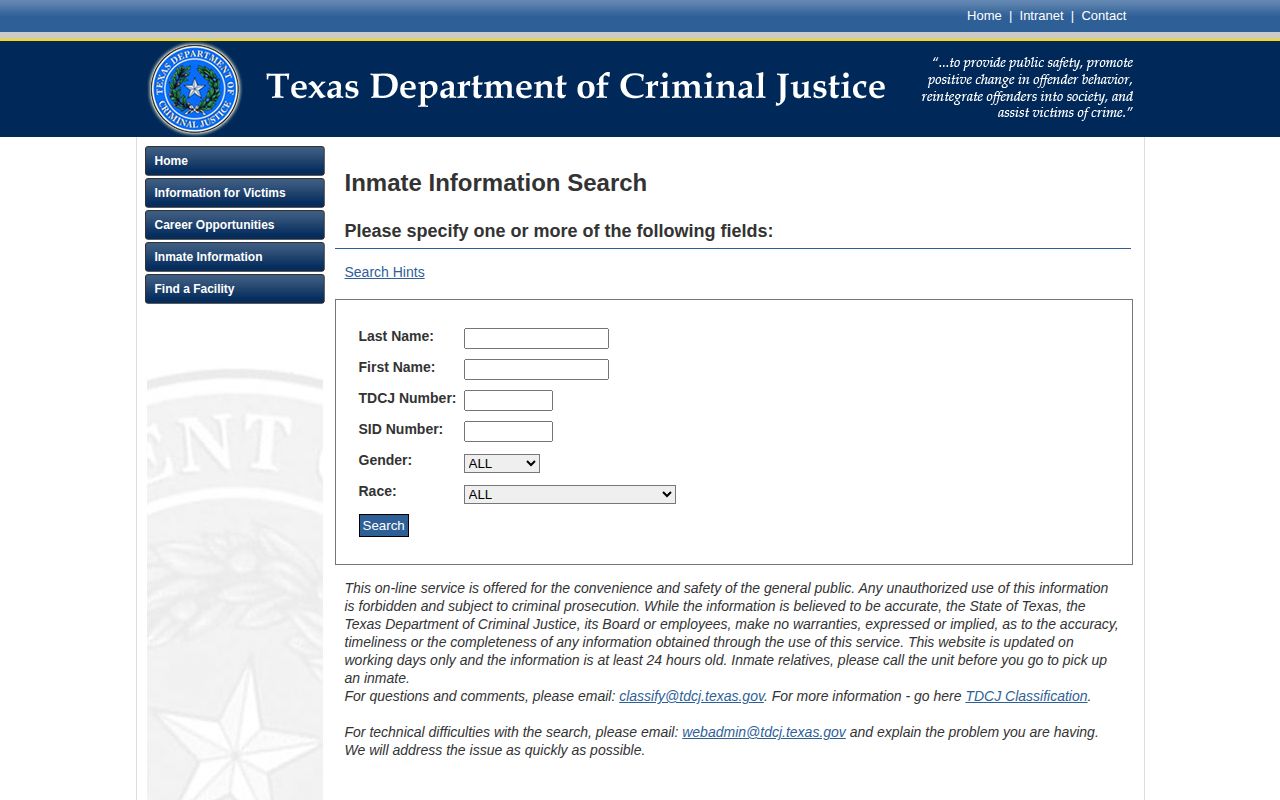
When the person stops appearing, record only that the current-only search returned no match on that date. Release, transfer, death, a spelling error, or update timing may explain the result.
Goliad Release Date by Email
TDCJ provides a no-charge email route when the public search fails or more supported facts are needed. Send the full name and seven-digit TDCJ number to TDCJ offender information. If the number is unknown, provide exact date of birth. If that is unavailable, give approximate age and county of conviction. Put the incarcerated person’s name in the subject.
The agency says this route can provide the TDCJ number, current location, conviction details, prior incarceration history, and projected release date. Ask specifically for release or discharge history when the goal is a completed event. Email assistance can distinguish a search mismatch from a current placement, but a response about a projection still is not proof of departure.
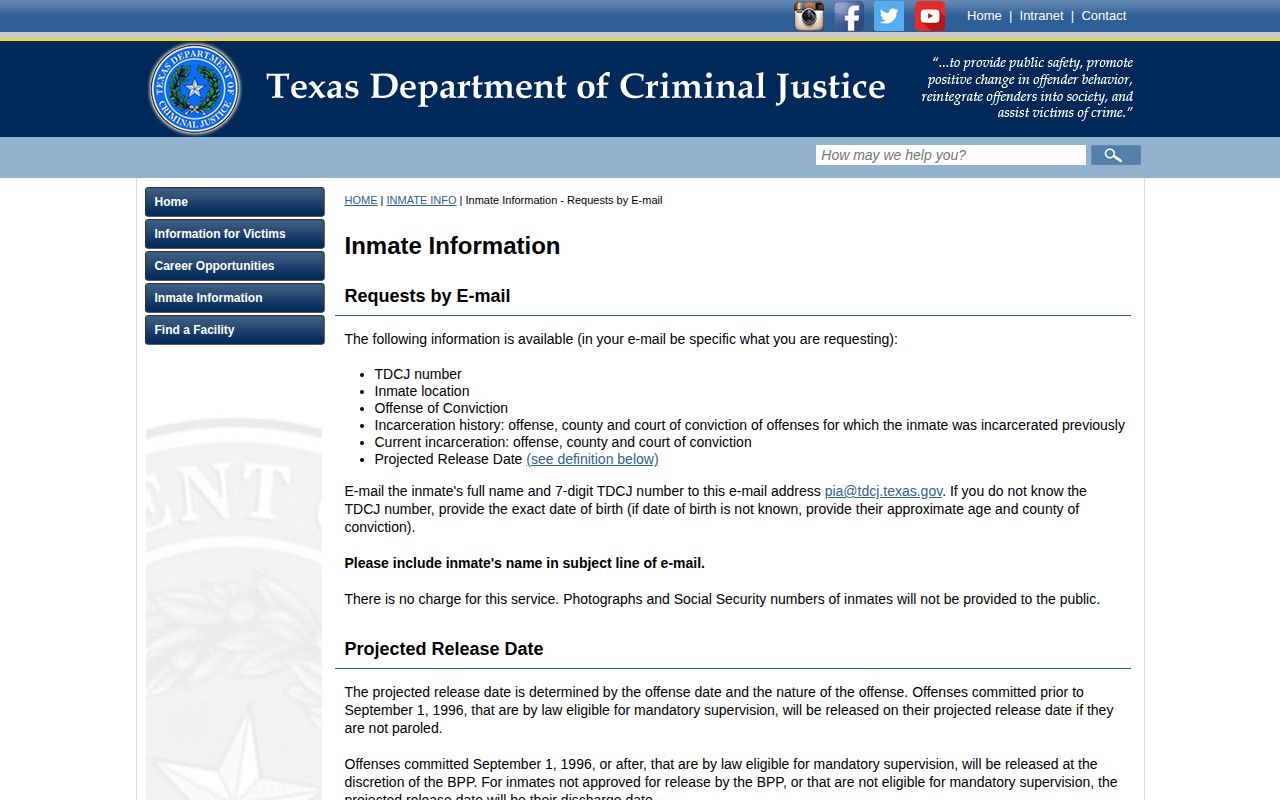
The captured page documents the available information and supports using the official contact route instead of guessing from a missing search result.
Goliad County Jail Date Records
A pretrial detainee may have a bond condition or court setting but no fixed release date. Holds, new orders, payment processing, or transfer paperwork can change the path. Never turn a hearing date into a predicted exit date.
For a sentenced county-jail stay, request the judgment, sentence length, jail credit, and any later order from the Goliad County and District Clerk. Then ask Goliad County Jail for the administrative event. The best release record states actual date and time, release type, authority, and destination or receiving agency.
A court order may establish time served before the jail finishes other checks. Staff may still have to clear warrants or detainers. Report the court event and administrative release as separate milestones. If only a date is available, label it date-only rather than supplying an estimated time.
What Changes Goliad Release Dates
Release dates can move for lawful and administrative reasons. The effect depends on the sentence and custody system.
| Factor | Possible effect | Verification source |
|---|---|---|
| Parole vote | May allow earlier release, often with conditions | Board result and TDCJ processing |
| Good-time credit | Affects parole or mandatory-supervision eligibility | TDCJ Classification and Records |
| Disciplinary action | May forfeit accrued good time | TDCJ disciplinary and calculation record |
| Discretionary mandatory supervision | Board denial may move projection to maximum expiration | Board result and current TDCJ field |
| Program or plan condition | Can delay processing after a favorable vote | TDCJ Review and Release Processing |
| Sentence correction | Changes credits, eligibility, or maximum date | Signed court order and TDCJ calculation |
| Detainer or hold | May produce transfer rather than community release | Releasing and receiving agencies |
| Update lag | Public field may trail agency action | Direct agency confirmation |
A transfer date is not a community-release date. Name the receiving authority and keep both custody records.
Texas Good Time for Goliad
Texas Government Code Section 498.003 states that good-conduct time applies to eligibility for parole or mandatory supervision. It does not otherwise shorten the sentence term. Section 498.004 allows forfeiture for disciplinary violations. Good time is therefore not a promise of release on a set day.
TDCJ describes three broad projected-date categories. For an eligible offense before September 1, 1996, flat time plus good time reaching the sentence may produce mandatory-supervision release if parole has not happened. Eligible later offenses also face Board review for discretionary mandatory supervision. A denial can move the date to maximum expiration. For an ineligible offense, the projection generally tracks maximum expiration unless parole occurs sooner.
Government Code Section 508.145 contains offense-specific parole rules. Under its general provision, calendar time plus good time may reach eligibility at one-fourth of the sentence or 15 years, whichever is less. Certain aggravated cases generally require one-half of the sentence or 30 calendar years, whichever is less, with good time excluded from that calculation. State-jail felons generally are not parole eligible.
Confirm a Goliad Actual Release
Before a parole decision, the Board status line is 844-512-0461. After a favorable vote, TDCJ Review and Release Processing at 512-406-5202 handles questions about physical release processing. The Victoria District Parole Office may help with assignment after release, but the release certificate controls reporting instructions.
For Goliad County Jail, call 361-645-8259 and ask whether the event was release or transfer. Follow with a written request when precision matters. For federal custody, BOP can show a past release date and “RELEASED,” meaning no longer in BOP custody. That does not rule out supervision or custody elsewhere. ICE and USMS have separate limits and routes.
A VINE alert is useful, but it is a notification rather than a certified record. The Goliad VINE inmate check can help monitor an event; confirm the reason, destination, and actual time with the reporting agency.
Reconcile Goliad Release Date Conflicts
A projected date in the past does not override a current TDCJ record. Review the current location, parole result, disciplinary credit, detainers, and processing status. If the online record disappears near an expected date, record the retrieval date and seek positive confirmation. The database’s working-day updates can lag an agency event.
A signed time-served judgment establishes the sentence result, but jail staff may still process papers or clear another hold. Do not publish the judgment time as the physical exit time. Ask the sheriff for the administrative release event. If VINE reports release while the docket shows a future setting, both may be correct because release from custody does not necessarily end the case.
BOP’s “Released” field means the person left BOP custody. A local, state, ICE, or USMS record may still show custody under another sovereign. Report each status with its agency and date. The same care applies when ICE returns no result, since locator coverage and lag make absence inconclusive.
The cleanest record keeps three fields separate: projected release date, confirmed actual release date and time, and sentence discharge date. This prevents a forecast, physical departure, and final completion from being presented as one event.
Public Record Search
Sponsored Results