
Goliad Release Supervision Paths
A person leaving Goliad County Jail does not automatically enter parole or probation. Bond may put a defendant back in the community while the criminal case continues. Time served or dismissal may end jail custody without creating supervision. Transfer to the Texas Department of Criminal Justice, often called TDCJ, continues custody and may later lead to parole or mandatory supervision.
Parole is conditional service of the rest of a prison sentence in the community. A panel of the Texas Board of Pardons and Paroles decides whether to grant it. TDCJ Parole Division then processes the approved release and supervises the person. Mandatory supervision is another statutory release framework. It may also require Board review. Discharge is different because it marks completion of the sentence or supervision term.
Probation, formally called community supervision in Texas, comes from a court. The signed judgment and community-supervision order establish it. A county or district court may later modify, revoke, or discharge the order. The jail’s release log can show when physical custody ended, but it does not replace the court order or the parole release certificate.
Compare Goliad Parole and Probation
The fastest way to choose a verification route is to identify who imposed the supervision and what custody came before it. These records answer different questions.
| Feature | Parole or mandatory supervision | Probation or community supervision |
|---|---|---|
| Source | State-prison sentence and Board/TDCJ action | County or district court order |
| Who supervises | TDCJ Parole Division | The relevant Community Supervision and Corrections Department |
| Best starting record | Release certificate, Board result, or TDCJ record | Signed judgment and supervision order |
| Physical release proof | TDCJ release processing record | Goliad jail release log if released locally |
| End of status | TDCJ discharge or other final action | Court discharge, revocation, or final order |
A parole date is not the same as a later discharge date. Likewise, an order granting probation does not by itself state the exact hour jail staff completed release processing.
Verify Goliad Post-Release Supervision
No substantiated statewide public name search covers every already released Texas parolee or ordinary probationer. TDCJ’s online inmate search includes only people currently incarcerated in a TDCJ facility. Use this evidence chain instead.
- Identify the custody path. Ask Goliad County Jail whether the person left for the community or transferred to a named authority.
- Find the signed court record. Obtain the judgment, sentence, community-supervision order, modification, revocation, or discharge from the Goliad County and District Clerk.
- For a state-prison case, check TDCJ. Search by TDCJ or SID number when possible. A current result may show parole-review data, but disappearance is not proof of release.
- Separate a vote from release. Before a decision, use the Board status route. After a favorable vote, ask TDCJ Review and Release Processing about physical release.
- Contact the assigned office. Follow the release certificate. For a parolee assigned through Goliad County, the directory points to Victoria District Parole Office.
- Record exact wording. Note whether the source says approved, released, transferred, supervised, discharged, revoked, or wanted.
Victoria Handles Goliad Parole Releases
TDCJ assigns Goliad County to the Victoria District Parole Office in Region IV. It is not a Goliad-based office, and it is separate from the office that handles court-ordered probation. A person must follow the office and reporting instructions on the release certificate, even if another office seems closer.
Victoria District Parole Office
Address: 100 N. John Stockbauer Drive, Victoria, TX 77901
Phone: 361-578-6022
Fax: 361-578-6402
Region: TDCJ Parole Division, Region IV
The office may answer reporting or assignment questions subject to privacy and identity rules. It is not the source for a Goliad jail bond release. For that event, call the jail at 361-645-8259 and request its release or transfer record.
The official directory image below confirms the Goliad-to-Victoria assignment. It should be read as an office routing record, not a list of supervised people.
View the TDCJ county-to-office directory.
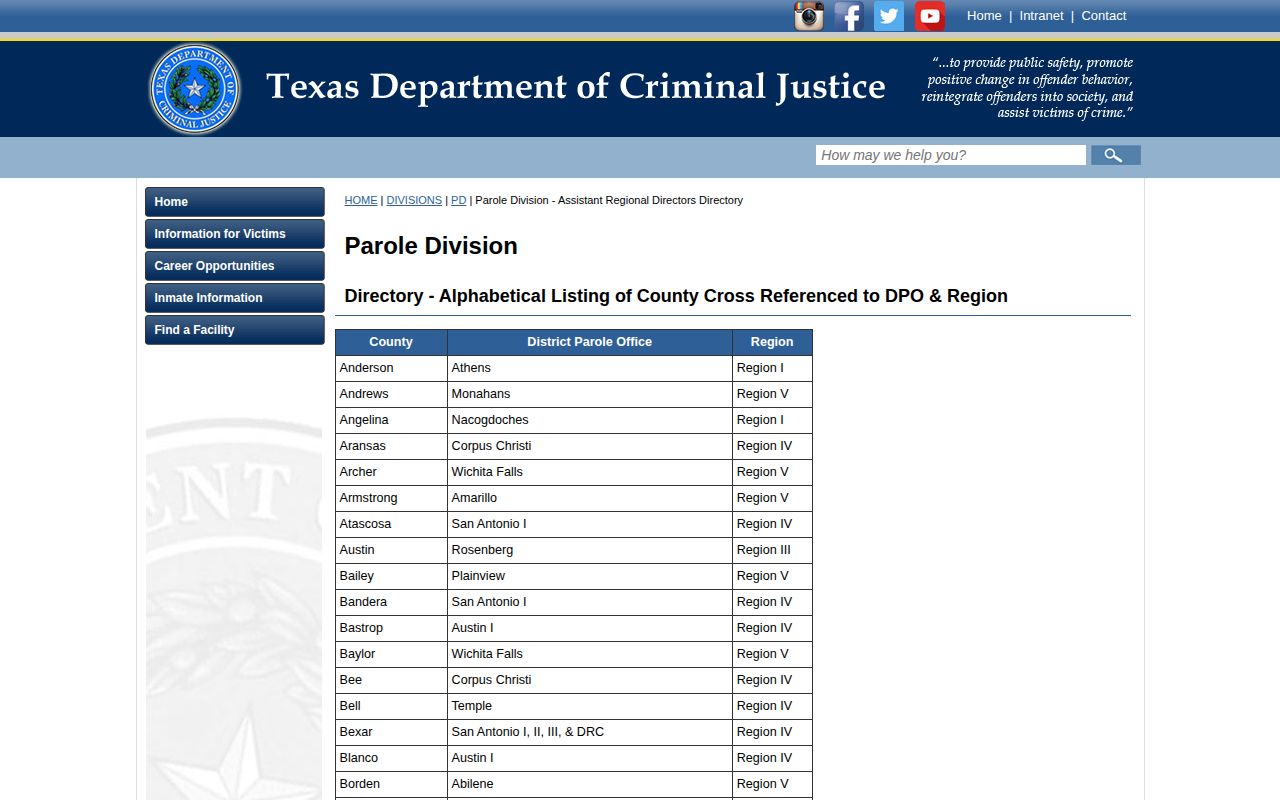
The directory supplies the correct operational contact while the individual release certificate controls the actual reporting instructions.
Goliad Parole Vote Versus Release
Texas parole consideration is generally a file review, not a formal public hearing for the incarcerated person. An Institutional Parole Officer prepares the case, and a three-member panel votes in sequence. Two matching votes decide the matter. A denial can set another review date. Favorable action can carry a date, program condition, transfer requirement, or other condition.
Approval still does not establish that the person walked out that day. TDCJ may need to approve a release plan, complete a program, resolve a detainer, or finish administrative processing. Before the Board’s decision, its status line is 844-512-0461. After a favorable vote, TDCJ Review and Release Processing at 512-406-5202 is the better route for actual processing status.
Review the official Texas parole process. The source image below shows the file-routing and vote sequence.
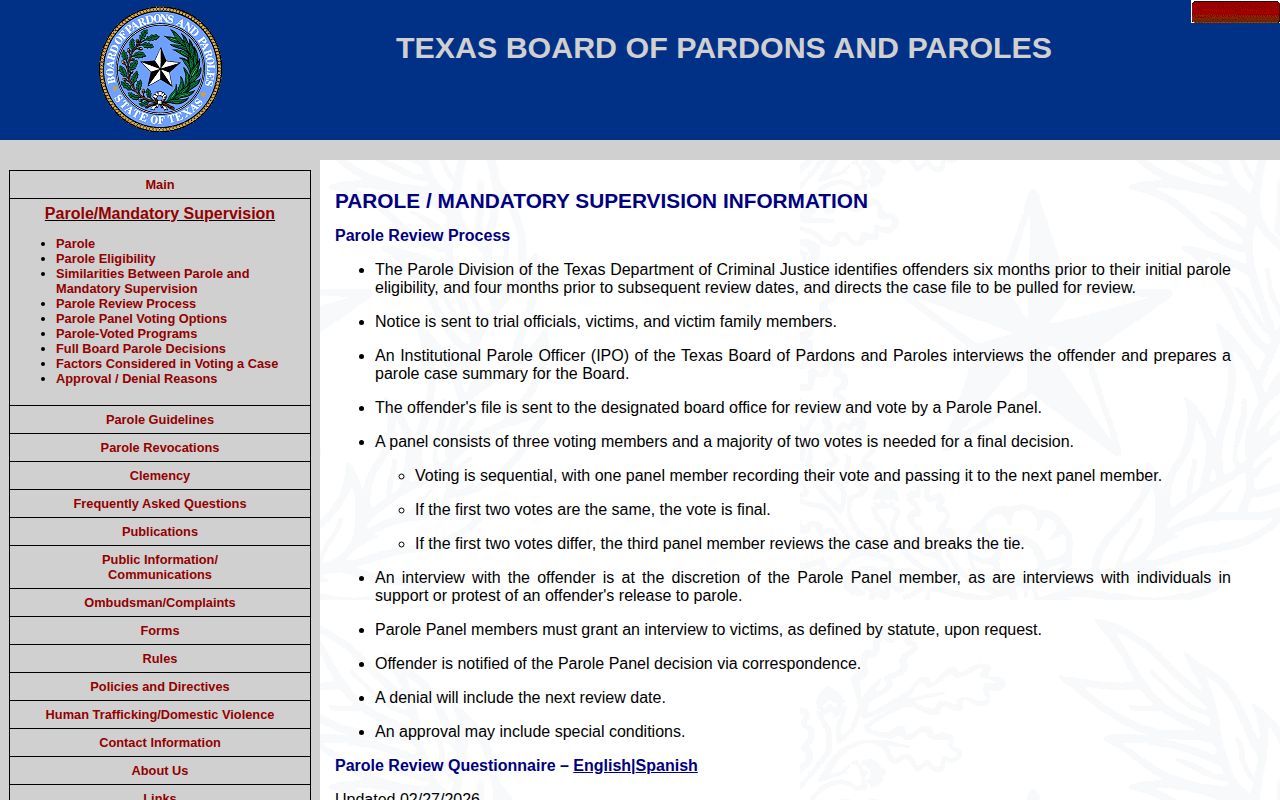
This sequence explains why a Board result and an actual TDCJ release record must be checked separately.
Goliad Probation Record Verification
There is no verified statewide public name locator for every person on ordinary Texas probation. Start with the Goliad County and District Clerk because the combined office routes both county misdemeanor and district felony records. Request the signed judgment and order of community supervision, plus any later modification, revocation, or discharge.
A docket is only a schedule. It may show a hearing date without revealing the signed result. The Goliad public-search link must also be checked for collection scope before assuming it contains criminal dispositions. When the online collection does not answer the question, contact the clerk at 361-645-3294 and identify the court and cause number if known.
The court order should identify the supervision term and conditions. Use the official court or county route to find the responsible Community Supervision and Corrections Department. Do not assume the Victoria parole office supervises probation. TDCJ’s Community Justice Assistance Division works with local departments but does not directly supervise each probationer.
Goliad Warrants and Alleged Violations
No official public statewide name search was found for all parole absconders or Goliad probation absconders. An inmate locator, an arrest post, or a local warrant page is not a complete substitute. Warrants can be sealed, recalled, unserved, or issued by different authorities.
For an alleged parole violation, confirm status through TDCJ Parole Division or the Board process. Preliminary and revocation hearings are different from the initial parole file review. They may address written allegations, evidence, representation, witnesses, and a written result. The supervising office can explain reporting requirements but may limit information about another person.
For an alleged probation violation, request the issuing court’s warrant, motion to revoke or adjudicate, hearing record, and final order. A new arrest does not by itself establish revocation. If immediate safety is involved, use the proper emergency channel. Routine records questions belong with the clerk, jail, or supervision office.
When Goliad Supervision Ends
A release to parole is not a sentence discharge. Parole and mandatory supervision keep conditions in force while the person serves the balance of a sentence in the community. The final discharge record, not the first release date, establishes the end of that status.
Probation also ends through a court event. The useful documents are a discharge order, final judgment, revocation order, or other signed disposition. A person can complete jail custody and still have an active court case or supervision duty. Conversely, a court may discharge supervision while an unrelated hold remains.
For a complete Goliad County record, reconcile three milestones: the jail or TDCJ physical release, the supervision start and assignment, and the later discharge. The broader Goliad County released-inmate search and records guide explains how to pair those records with the sheriff’s release log and court file.
Read Goliad Supervision Documents
Keep the source and date attached to each fact. A release certificate may name the assigned office, reporting deadline, and special instructions. A Board notice records a decision, while a TDCJ processing response addresses whether the approved move has occurred. The judgment states the sentence, and a separate court order may set or change probation. These papers should not be collapsed into one status.
Terms also matter. “Approved” describes a decision, not a completed departure. “Released to parole” means incarceration ended under conditions, not that the sentence vanished. “Discharged” ordinarily marks completion. “Revoked” means the deciding authority withdrew community supervision after the required process. “Transferred” means custody continued with another agency.
When two records differ, do not pick the result that seems most likely. Note the exact wording, agency, record number, and retrieval time. Ask the office closest to the disputed event to clarify. The jail controls its exit log, TDCJ controls its release processing, the court controls its signed orders, and the supervision office controls current reporting assignment.
Public Record Search
Sponsored Results